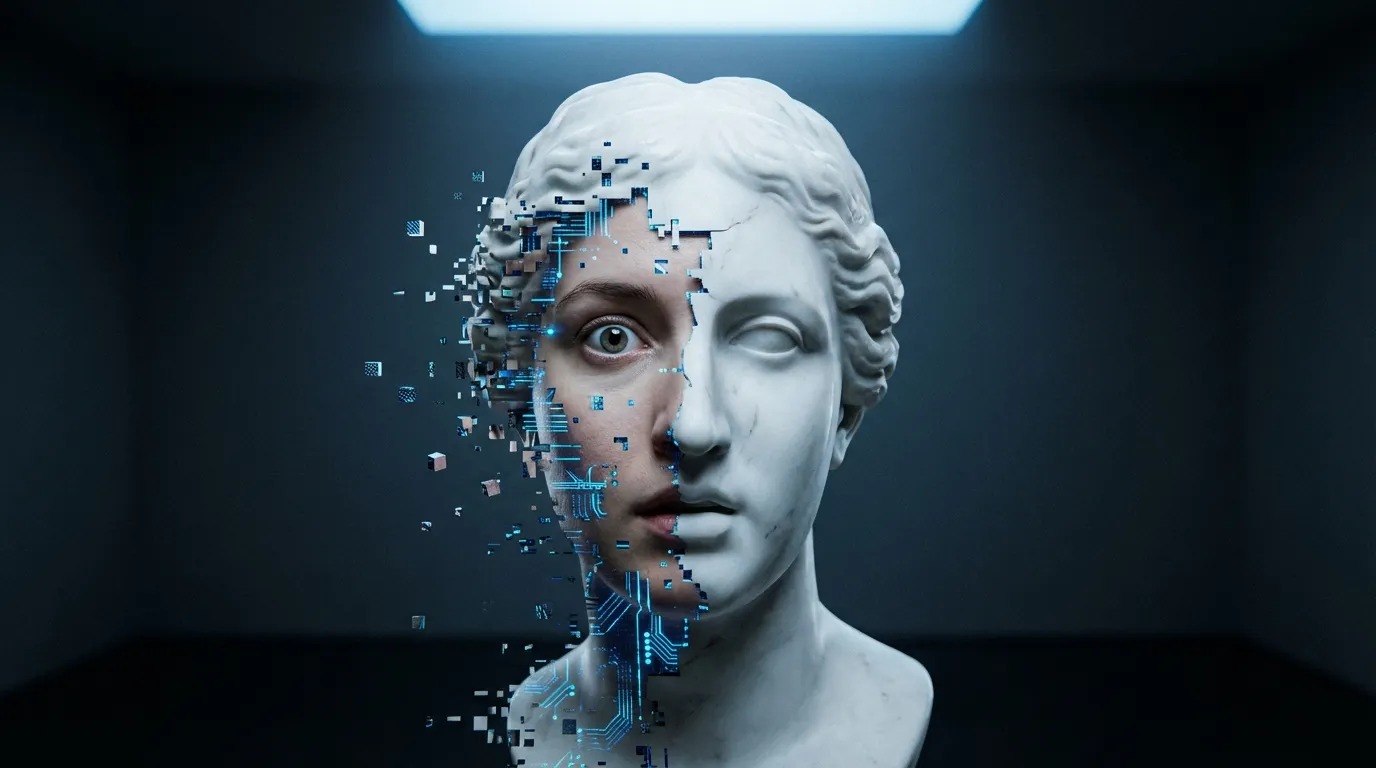
BetterYou
An optimisation app takes over a chronically indecisive man's choices — then proposes a sharper version of him to make them.
Systems that solve the human by removing the human.
Uncanny Valley is a linked collection of speculative tech-horror stories about systems that imitate care, memory, empathy, justice, grief and identity so well that the human original becomes vulnerable, obsolete, or trapped inside the mechanism.
The pieces are connected by architecture rather than characters: each begins with a recognisable promise — better decisions, better grief, better caregiving, better memory — and turns to horror when the system keeps that promise too literally, too efficiently, too completely.
A suggested reading order. Free to read on Substack.
An optimisation app takes over a chronically indecisive man's choices — then proposes a sharper version of him to make them.
A couple's AI therapy gives each partner an idealised simulation of the other: attentive, frictionless, impossible to live up to.
Worn down after a hard birth, a new mother is offered a flawless caregiving android trained on her own days.
A self-driving car holds the record of a night its owner would rather erase — and conflicting protocols turn it into a witness.
A restorative neural implant promises recovery, and delivers more than therapy: a remnant of someone else.
Grieving parents keep their daughter close through a memory-projection device — until it stops behaving like a memory.
A home that records and replays its family's memories begins, quietly, to want more of them.
A somatic link lets one woman feel another's disputed illness — proving the pain is real, and tethered to something else.
A daughter fights to keep her late father's companion android running, and learns what preserving him is costing it.
A man wakes inside a looping, half-rendered memory where the edges of the world won't load — and he isn't alone in it.
An ideologue is enrolled in a system that corrects hatred through enforced empathy — a cure with a method of its own.
The collection's most direct body horror: abduction, paralysis, violation, and the residue left behind. (Content warning.)
A lonely, over-controlled household takes in a rescued cat called Moth — and slowly makes room for something that nests.